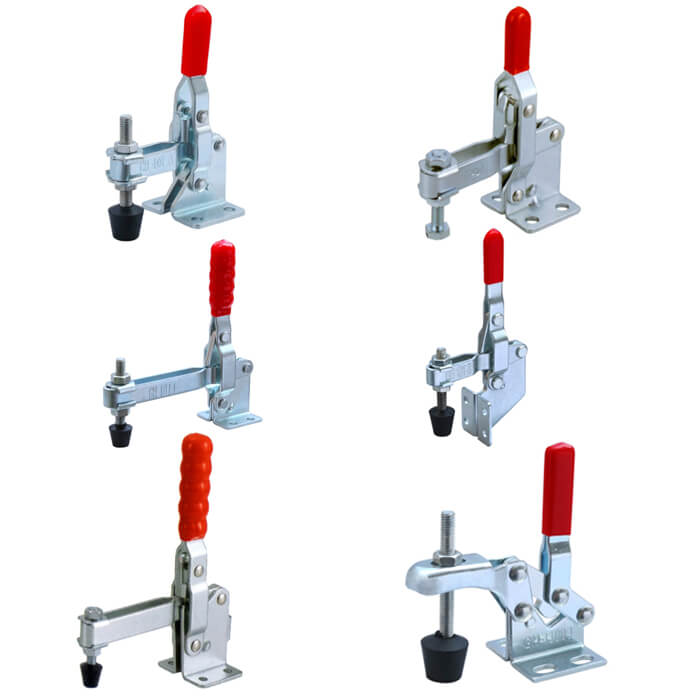
A vertical toggle clamp is a manual workholding tool designed to securely fasten workpieces in place by applying downward clamping force. It’s a fundamental component in various manufacturing processes, providing a reliable and efficient way to hold materials during machining, welding, assembly, and more.
Understanding the Vertical Toggle Clamp
Vertical toggle clamps are characterized by their vertically oriented handle, which moves up and down to engage and disengage the clamping mechanism. This design offers a compact horizontal footprint while requiring vertical clearance for handle operation.
Key Components
A vertical toggle clamp consists of several key components that work in unison:
- Handle: The lever used to activate the clamping action.
- Pivot Point (Spindle): The central point around which the mechanism pivots.
- Clamping Arm: The arm that moves to apply pressure to the workpiece.
- Base Plate: Provides a stable foundation for the clamp.
- Clamping Pad: The part that directly contacts the workpiece, often featuring a rubber tip to prevent damage.
Design and Operation Explained
In the released position, the handle typically lies flat and parallel with the clamping arm. Pulling the handle upward engages the clamping mechanism. The pivot point pulls the clamping arm down, applying downward pressure onto the workpiece. This simple two-position design makes the clamp intuitive to use: up for clamping, down for releasing.
Key Capabilities and Holding Capacity
Vertical toggle clamps are known for their impressive holding capacities.
Holding Force
Standard applications often provide holding capacities ranging from 100 to 1,000 pounds. Heavy-duty models can provide clamping forces up to approximately 5,060 pounds, making them suitable for demanding tasks. This significant mechanical advantage comes from a system of pivoting levers and links that convert manual force into a secure clamping action.
Mechanical Advantage
The design of a vertical toggle clamp provides a significant mechanical advantage. This allows users to apply substantial clamping force with minimal effort, ensuring workpieces are held firmly in place.
Space Considerations and Footprint
One of the defining advantages of vertical toggle clamps is their efficient use of space.
Compact Horizontal Footprint
They take up minimal space in the lateral direction, making them ideal for setups where horizontal space is limited.
Vertical Clearance Requirements
However, they require adequate vertical clearance above the workpiece to accommodate the upright handle movement. This makes them perfect for situations where overhead space is available.
Common Applications of Vertical Toggle Clamps
Vertical toggle clamps excel in environments requiring strong downward pressure and precision.
Automated Robotic Setups
Their reliability and consistent pressure make them ideal for automated robotic setups.
Welding Stations
They provide significant downward force to hold components securely during welding.
Assembly Lines
Quick engagement and disengagement streamline production on assembly lines.
Manufacturing Fixtures
They are essential for drilling, cutting, and sanding operations. Their robust design and ability to maintain consistent pressure make them valuable in quality-sensitive manufacturing processes.