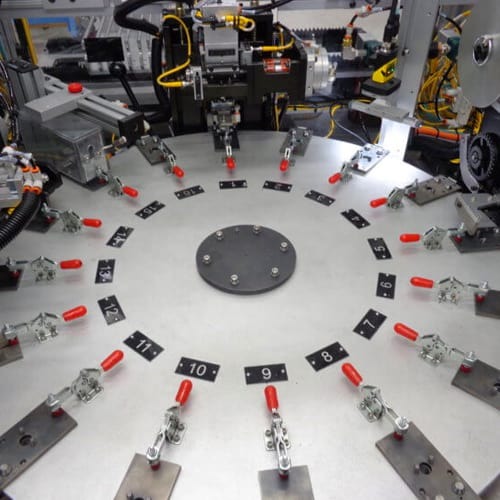
Toggle clamps are mechanical tools that hold workpieces firmly in place with a simple lever action. They lock materials down quickly and release them just as fast, making them essential in workshops, factories, and home projects. These clamps use a handle mechanism that creates strong holding pressure when you flip it into the locked position.
Toggle clamps give you a fast, repeatable way to secure materials without constantly adjusting bolts or screws, which saves you time and keeps your workpieces positioned exactly where you need them. They come in many styles and sizes to match different jobs. Some push down on materials, while others pull or hold sideways.
When you understand how toggle clamps work and which type fits your needs, you can improve your work speed and accuracy. This guide covers everything from basic types to choosing the right clamp for your specific application.
Key Takeaways
- Toggle clamps use a lever mechanism to quickly secure and release workpieces without constant adjustments
- Different toggle clamp types serve specific purposes, from vertical holding to horizontal pulling applications
- Selecting the right toggle clamp depends on your holding force requirements, mounting space, and material type
What Are Toggle Clamps?
Toggle clamps are mechanical tools that use a lever and linkage system to hold objects firmly in place with quick operation and strong clamping force. You can lock them in position with minimal effort and release them just as easily when your work is complete.
Definition and Purpose
Toggle clamps are hand-operated fastening devices designed to secure workpieces quickly during manufacturing, woodworking, welding, and assembly operations. They use a toggle mechanism that multiplies the force you apply to the handle, creating strong holding power at the clamping point.
You’ll find toggle clamps useful when you need to hold parts in the same position repeatedly. They speed up production work because you can clamp and unclamp objects in seconds without adjusting screws or bolts. The clamps stay mounted to your workbench or jig, ready for the next piece.
These tools serve industries where workers need consistent, reliable holding force. Metal fabricators use them to position parts for welding. Woodworkers rely on them to secure boards during cutting or gluing. Assembly line workers use them to hold components while fasteners are installed.
Key Features and Components
Toggle clamps include several essential parts that work together. The handle is what you push or pull to operate the clamp. The linkage system consists of connected pivot points that create the toggle action and multiply your applied force.
The clamping arm extends from the linkage to contact your workpiece. At its end sits the pressure pad or contact point, often made of rubber or plastic to protect the surface you’re clamping. A mounting base attaches the entire assembly to your work surface or fixture.
Adjustment screws let you fine-tune the clamping pressure and position. The locking mechanism holds the handle in the closed position until you release it. Most toggle clamps use steel construction for durability, with some components made from stainless steel for corrosion resistance.
Advantages of Toggle Clamps
Toggle clamps save you significant time compared to traditional C-clamps or screw clamps. You can secure a workpiece in under two seconds with one hand motion. This speed matters when you’re processing dozens or hundreds of parts.
The clamping force stays consistent each time you lock the handle. You don’t have to guess how tight to make it or worry about variations between pieces. This consistency improves the quality of your finished work.
Your hands stay free once the clamp is locked. You can operate tools, position additional parts, or make measurements without holding anything in place. The clamps also maintain their position through vibration and movement that might loosen other fastening methods.
Types of Toggle Clamps
Toggle clamps come in four main design categories, each suited for different clamping directions and workspace requirements. The design you choose depends on whether you need downward pressure, side clamping, pulling force, or pinching action.
Hold Down Toggle Clamp Designs
Hold down toggle clamps push workpieces straight down onto your work surface. These are the most common type you’ll find in workshops and manufacturing settings.
The vertical handle version features a handle that moves up and down in a vertical arc. When you push the handle down, it applies force directly onto your workpiece through a plunger or arm. This design works well when you have overhead clearance and need quick access to the clamp handle.
The horizontal handle model operates with the handle moving in a horizontal plane. You push the handle forward or to the side to engage the clamp. This design saves vertical space, making it useful when you’re working in tight areas or under low-hanging equipment.
Both styles lock in place when you push the handle past center point. The toggle mechanism creates mechanical advantage, letting you generate significant clamping force with minimal effort.
Vertical and Horizontal Handle Toggle Clamps
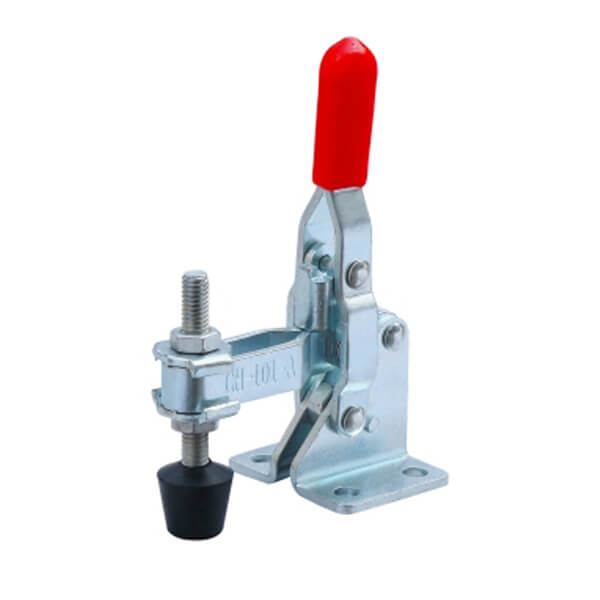
Your choice between vertical and horizontal handles affects how you access and operate the clamp. Vertical handle toggle clamps require space above the clamp for the handle to move through its arc.
These clamps typically provide easier operation when you’re standing directly over your workpiece. The downward pushing motion feels natural and lets you use your body weight if needed.
Horizontal handle toggle clamps extend parallel to your work surface when engaged. They’re ideal for applications where you have limited overhead space or need to mount clamps on the side of fixtures. You can often operate multiple horizontal clamps in sequence more quickly since your hand moves in a straight line across them.
Pull/Latching Toggle Clamps
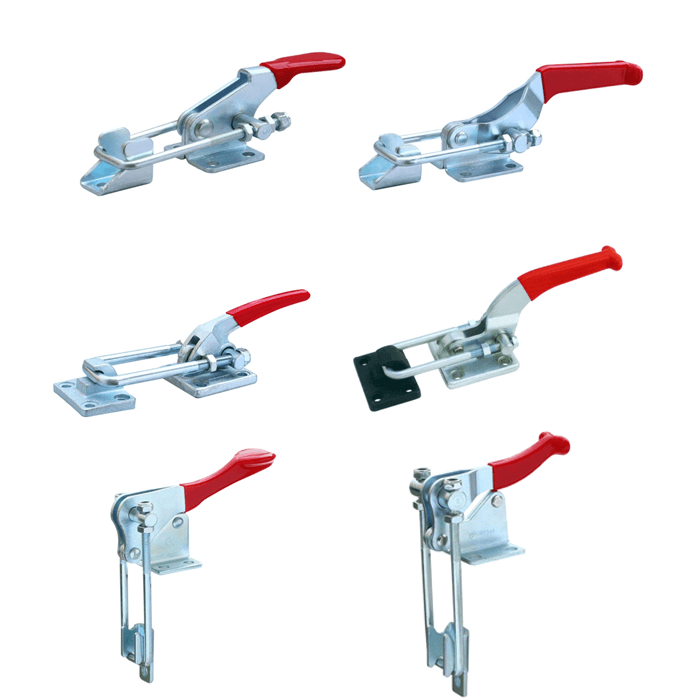
Pull toggle clamps create tension by pulling rather than pushing. You attach one end to your workpiece and the other to a fixed point, then engage the handle to draw the two points together.
These clamps excel at holding doors shut, securing lids, or pulling panels tight against frames. They’re common on toolboxes, equipment cases, and access panels. The pulling action creates a tight seal that holds even when exposed to vibration.
Latching toggle clamps lock in place without requiring you to hold them. Once engaged, they stay closed until you manually release them. This makes them perfect for applications where you need consistent holding force over extended periods.
Squeeze Action Toggle Clamps
Squeeze action toggle clamps work like pliers with a locking mechanism. You squeeze the handles together to grip your workpiece, and the toggle locks them in place.
These clamps hold objects from two sides simultaneously, creating balanced pressure. They’re useful for delicate parts that might shift under one-sided pressure from a hold down toggle clamp. The pinching action centers your workpiece automatically.
You’ll find squeeze action designs in welding fixtures where you need to hold two pieces together for joining. They’re also popular for securing round or irregularly shaped objects that would be difficult to clamp from above.
Straight Line (Push-Pull) Toggle Clamps
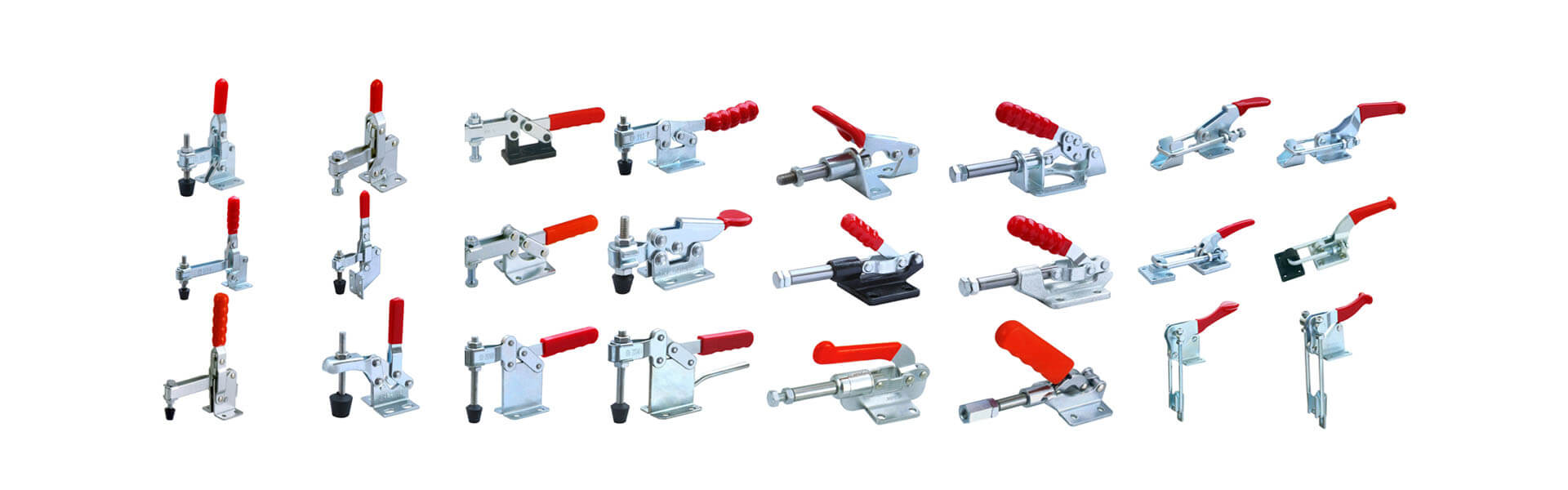
Straight line toggle clamps move the clamping arm in a direct push or pull motion rather than in an arc. This design lets you apply force along a straight path, which works well when you need to push or pull workpieces into precise positions.
Operation Mechanism
The straight line toggle clamp uses a linkage system that converts the handle’s arc motion into linear movement at the clamping point. When you press the handle down, the linkage mechanism pushes the clamp arm forward in a straight line. The toggle action locks at the end of the stroke, maintaining constant pressure on your workpiece.
Most models include an adjustment screw that lets you fine-tune how far the arm extends. You can set the exact clamping distance based on your workpiece thickness. The handle typically moves through 90 to 180 degrees of travel to engage the clamp fully.
Typical Applications
You’ll find straight line toggle clamps in welding fixtures where they push parts together before joining. They work well in assembly operations that require parts to slide into alignment as the clamp engages.
These clamps are common in:
- Woodworking jigs – holding boards flush against fences
- Metal fabrication – pushing sheet metal flat against dies
- Packaging equipment – pressing boxes closed during sealing
- Testing fixtures – positioning samples against measurement surfaces
The straight-line action makes them useful when you need to close gaps between parts or press components into recesses.
Benefits of Straight Line Toggle Clamps
The main advantage is the direct force application along a single axis. You get predictable clamping that won’t shift your workpiece sideways during engagement.
These clamps take up less vertical space than vertical toggle clamps since the motion happens horizontally. This compact design helps in tight work areas or when you need to stack multiple fixtures.
The push-pull action naturally seats parts into position as it clamps. You don’t need a separate positioning step before securing the workpiece. The linear motion also reduces wear on the clamping surfaces since there’s no sideways sliding during operation.
Applications and Industries
Toggle clamps serve essential roles in manufacturing and production settings where you need quick, repeatable clamping force. These tools appear across metalworking, woodworking, automotive, and assembly operations where speed and consistency matter.
Fixture Plates and Assembly Tables
You’ll find toggle clamps mounted on fixture plates and assembly tables in almost every manufacturing facility. These setups let you position and secure parts in the exact same spot every time. The clamps hold workpieces steady while you drill, glue, or assemble components.
Fixture plates use multiple toggle clamps to create custom holding patterns for specific parts. You can arrange vertical, horizontal, or push-pull clamps based on your workpiece shape. This setup cuts down on setup time between jobs.
Assembly tables benefit from toggle clamps because workers can load and unload parts with one hand. The quick-release mechanism means you don’t waste time threading screws or adjusting traditional clamps. Many shops mount clamps on T-slot tables for flexible positioning.
Welding and Fabrication
Welding shops rely on toggle clamps to hold metal parts in place during joining operations. The clamps keep pieces aligned while you tack weld or complete full welds. This prevents parts from shifting due to heat or vibration.
Common welding applications include:
- Frame assembly and tube fabrication
- Sheet metal joining and bracket welding
- Jig and fixture construction
- Tack welding operations
You need clamps that can handle heat and sparks in welding environments. Many fabricators choose all-metal toggle clamps for this reason. The holding force must be strong enough to resist warping as metal heats and cools.
Latch-action clamps work well for repetitive welding tasks. You can position the workpiece, clamp it down, complete the weld, and release in seconds.
Inspection Stations
Quality control stations use toggle clamps to hold parts during measurement and testing. The clamps position items consistently so you can check dimensions with calipers, micrometers, or CMM equipment. Parts must stay completely still during inspection to get accurate readings.
You can set up inspection fixtures with clamps that match your part geometry. This ensures each piece sits in the same orientation for checking. Toggle clamps with adjustable arms accommodate slight size variations between parts.
Testing equipment often requires secure clamping while sensors or probes make contact with the workpiece. The clamps prevent movement that could give false readings or damage measuring tools.
Production and Processing Lines
Toggle clamps appear throughout production lines where you need to secure items for specific operations. Conveyor systems use them to stop and hold parts at work stations. The clamps engage automatically when a part reaches the correct position.
CNC machines and machining centers use toggle clamps in work-holding fixtures. You can load raw material, clamp it down, and let the machine run its program. Pneumatic toggle clamps connect to the machine control system for automatic operation.
Packaging lines use toggle clamps to hold boxes, bottles, or products during filling, sealing, or labeling. The clamps release when the operation completes so the item can move to the next station.
How to Select the Right Toggle Clamp
Choosing the right toggle clamp depends on three main factors: how much force you need, what the clamp is made from, and how you’ll attach it to your work surface.
Load Capacity and Size Considerations
The holding capacity tells you how much force a toggle clamp can apply to your workpiece. This measurement appears in pounds or newtons on the product specifications. You need to match the clamp’s capacity to your actual needs.
Start by calculating the force required to hold your workpiece securely. Add a safety margin of 25-50% to account for unexpected movement or vibration. A clamp that’s too weak won’t hold properly, while an oversized clamp wastes money and takes up unnecessary space.
The clamp size also affects where you can use it. Measure your available mounting space before buying. Check the throat depth, which is the distance from the handle to the clamp arm. This determines how far the clamp can reach onto your workpiece.
Consider the opening capacity as well. This is how wide the clamp opens to accept your material. Make sure it’s larger than your thickest workpiece.
Material and Construction Options
Toggle clamps come in steel, stainless steel, and plastic construction. Steel clamps offer the best strength for heavy-duty applications. They resist wear and handle high forces well.
Stainless steel clamps cost more but resist rust and corrosion. You should choose these for wet environments, food processing, or outdoor use. They maintain their appearance and function longer in harsh conditions.
Plastic toggle clamps work well for light-duty tasks. They won’t scratch delicate surfaces and resist chemicals better than metal. However, they can’t handle heavy loads or high temperatures.
The quality of moving parts matters too. Look for hardened steel pins and wear-resistant bushings. These features extend the clamp’s working life and maintain consistent holding force.
Mounting Methods
Toggle clamps attach to surfaces in several ways. The most common method uses base mounting holes. You drill holes in your work surface and bolt the clamp down firmly. This provides the strongest, most stable attachment.
Some clamps feature flanged bases with multiple mounting holes. These distribute forces over a larger area and work well on thinner surfaces. You can also position them at different angles for better access.
Welded mounting works for permanent installations. You weld the clamp base directly to a metal surface. This creates a solid connection but makes repositioning impossible.
Quick-release mounting systems let you move clamps between locations. These use T-slots, rails, or magnetic bases. They’re useful when you need flexibility, though they don’t hold as firmly as bolted connections.
Safety, Usage, and Maintenance
Toggle clamps require proper installation and regular maintenance to work safely and effectively. Following safety guidelines protects you from injury and extends the life of your equipment.
Proper Installation Techniques
Mount your toggle clamp on a flat, stable surface that can handle the clamping force. You need to secure it with bolts or screws that match the mounting holes. Make sure the surface is clean and free of debris before installation.
Position the clamp so the handle has enough clearance to move through its full range of motion. Check that the clamp arm aligns with your workpiece when closed. Tighten all fasteners to the manufacturer’s specified torque settings.
Test the clamp without a workpiece first. Open and close it several times to verify smooth operation. Adjust the spindle or pressure screw to set the correct clamping force for your application.
Maintenance Best Practices
Clean your toggle clamps regularly to remove dust, chips, and debris that can affect performance. Use a soft brush or compressed air for routine cleaning. Wipe down metal surfaces with a clean cloth.
Lubricate moving parts every few months with light machine oil. Apply a small amount to pivot points, the handle mechanism, and the spindle threads. Avoid over-lubricating, which attracts dirt.
Inspect clamps before each use for worn or damaged parts. Look for cracks in the handle, loose fasteners, or bent components. Replace worn parts immediately to maintain safe operation.
Check the clamping force periodically using a force gauge. Adjust the spindle as needed to maintain consistent pressure.
Common Safety Precautions
Never exceed the clamp’s rated holding capacity listed in the manufacturer’s terms and conditions. Overloading can cause the clamp to fail or damage your workpiece.
Keep your hands and fingers clear of the clamping area when closing the handle. The rapid closing action can cause pinch injuries.
Wear safety glasses when operating toggle clamps, especially during machining or cutting operations. Flying debris poses a risk to your eyes.
Do not modify or alter your toggle clamp from its original design. Changes can compromise structural integrity and void warranty terms and conditions. Replace damaged clamps rather than attempting makeshift repairs.
Ensure workpieces are properly supported and positioned before clamping. Unstable items can shift during operation and cause injury.
Purchasing Considerations and Compliance
Buying toggle clamps requires attention to supplier reliability, product certifications, and legal agreements that protect your interests. These factors ensure you get quality products that meet safety standards and comply with regulations.
Supplier Selection Criteria
When you choose a toggle clamp supplier, start by checking their industry experience and reputation. Look for companies that have been in business for several years and have positive customer reviews. Ask for references from other businesses in your industry.
Check if the supplier offers technical support and product documentation. You need clear specifications, installation guides, and troubleshooting resources. Good suppliers provide CAD drawings and dimensional data for their clamps.
Compare pricing across multiple suppliers, but don’t base your decision on cost alone. The cheapest option often leads to quality problems or hidden fees. Look at the total value including shipping costs, minimum order quantities, and return policies.
Verify that the supplier maintains adequate inventory levels. You don’t want production delays because clamps are backordered. Ask about lead times for standard items and custom orders.
Quality and Certification Standards
Your toggle clamps should meet relevant industry standards and certifications. Common certifications include ISO 9001 for quality management and RoHS compliance for material safety. Some applications require clamps that meet specific load ratings certified by independent testing labs.
Request material certifications and test reports from your supplier. These documents verify that the clamps are made from the specified materials and can handle the stated holding forces. Keep these records for your quality control files.
Inspect samples before placing large orders. Test the clamps for smooth operation, proper alignment, and secure locking. Check for burrs, rough edges, or coating defects that could affect performance.
User Agreements and Compliance
Read the supplier’s terms and conditions carefully before ordering. These agreements cover warranty terms, liability limits, and dispute resolution procedures. You need to understand what protections you have if products are defective or damaged during shipping.
Review the supplier’s privacy policy if you purchase through their website. This policy explains how they collect, use, and protect your business information and payment data. Make sure they use secure payment processing and don’t share your information with third parties without consent.
Check warranty coverage and duration. Most quality toggle clamps come with at least a one-year warranty against manufacturing defects. Understand what the warranty covers and what actions void it.
Keep copies of all purchase orders, invoices, and correspondence with your supplier. This documentation helps resolve disputes and supports warranty claims.
Frequently Asked Questions
Toggle clamps come in several types with specific holding capacities and installation requirements. Regular maintenance and proper safety practices help these tools work effectively for years.
What are the different types of toggle clamps and their applications?
Horizontal toggle clamps hold workpieces flat against a surface. You’ll find these in woodworking shops and assembly lines where parts need to stay in place during drilling or gluing.
Vertical toggle clamps push down from above. These work well for machining operations and welding fixtures where you need top-down pressure.
Push-pull toggle clamps can both push and pull. You can use them for applications that require holding objects in either direction.
Latch clamps lock doors and covers shut. They’re common on equipment cases and machine guards.
How do you determine the right size and holding capacity for a toggle clamp?
You need to calculate the force required to hold your workpiece securely. Check the weight of your material and add at least 20-30% extra capacity for safety.
The clamp’s holding capacity appears on its specification sheet. This number tells you the maximum force the clamp can apply at its handle.
Measure your workspace to ensure the clamp fits without interfering with other tools. The clamp arm needs enough clearance to open and close fully.
What are the steps for properly installing a toggle clamp?
Mark the mounting location on your work surface first. Position the clamp where it will apply pressure to the strongest part of your workpiece.
Drill pilot holes for the mounting bolts. Use the clamp’s base as a template to get the hole spacing right.
Secure the clamp with bolts appropriate for your surface material. Metal surfaces need machine screws while wood requires wood screws or bolts with washers.
Test the clamping action before using it on actual work. Adjust the position if needed to ensure proper contact with your workpiece.
Can toggle clamps be used for both horizontal and vertical applications?
Most toggle clamps are designed for specific orientations. A horizontal clamp won’t work properly if you mount it vertically.
Some manufacturers make multi-directional clamps that work in various positions. Check the product specifications to verify acceptable mounting angles.
The clamp’s holding capacity can change based on its orientation. Always follow the manufacturer’s guidelines for your specific mounting position.
How do you maintain and ensure the longevity of a toggle clamp?
Clean your toggle clamps regularly to remove dust, chips, and debris. These particles can get into the pivot points and cause wear.
Apply light machine oil to all moving parts every few months. This prevents rust and keeps the action smooth.
Inspect the clamp for worn parts before each major project. Look for cracks in the handle, loose rivets, or damaged contact pads.
Replace worn components immediately to maintain holding strength. Most manufacturers sell replacement parts for their clamps.
What safety precautions should be taken when operating toggle clamps?
Keep your fingers clear of the clamp arm when closing it. The handle can snap shut quickly and pinch your hand.
Wear safety glasses when working with toggle clamps. Flying debris from your workpiece can cause eye injuries.
Never exceed the clamp’s rated capacity. Overloading can cause the clamp to fail and release your workpiece unexpectedly.
Check that the clamp is fully engaged before starting work. A partially closed clamp may let your workpiece slip during operations.